Pieds dans l’eau on the West African coast: Les Almadies
It’s mid-June 2026, and I have just arrived in Senegal for a two-day event in Dakar. I consider this my first real time here, because when I came in February I was in Diamniadio and saw nothing besides a stadium and the hotel.
I get lucky on the way to Dakar and win a free upgrade to business class, so I don’t feel the usual fatigue.
My colleagues invite me for dinner and ask what I would like to eat.
“Something traditional Senegalese.”
“T’es sûre? Are you sure?”
“Bien sûr. I didn’t come all the way to Dakar to eat a pizza or a burger. I want to feel I am in Senegal.”
“Perfect. Then what would you like to eat?”
“Which are the options?”
“Seafood or meat?”
“Let’s go for seafood!”
Hospitality is important in Senegal; it’s one of the pillars of their traditions. Teranga, as they say in Wolof, is not just a matter of comfort and courtesy. It is an extensive form of protection, deeply rooted in their culture, with a scent of ancient times, almost biblical.
Teranga warms your heart, provided that you are open to receiving it and don’t see it as a limitation that they basically won’t allow you to take a single step alone: not because they don’t trust you, but because they value you as a guest.
As a woman travelling solo, I have learnt to appreciate this form of protection a lot. I am with people I can trust, so I can relax, I can learn, I can experience the country at a level I’d never reach if I were on my own. I don’t need to worry about anything because they take care of me, and this too is a form of freedom.
So, they take me to the seaside at Les Almadies, one of the nicest areas of the city. We park and walk along the street to pick a restaurant on the shore.
“Terrasse avec la vue ou pieds dans l’eau ? Terrace with the view or feet in the water?”
“Pieds dans l’eau, évidemment. Feet in the water, of course.”
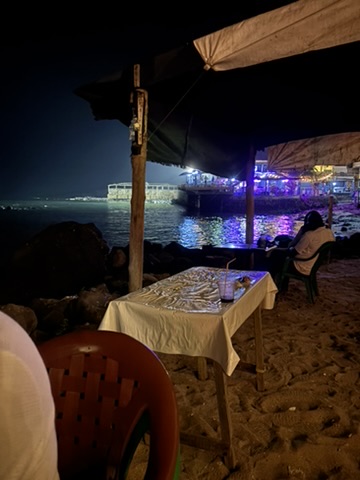
My colleague turns right into a narrow side street that leads us directly to the beach. We are now in front of a small concrete building. A few plastic tables and chairs are set on the beach.
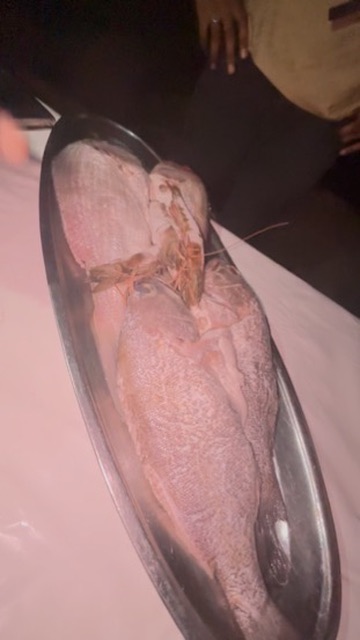
After the initial discussion about seafood, we move on to fish as well. The waiter comes to us with a dish holding a few fish and asks us to pick the ones we want to eat. That’s when I realize I won’t be able to finish dinner, because they are ordering for me to taste as much as possible: it would be impossible even if I had been fasting for days. So I pick my fish (a “thiof”, a white grouper) – I try to choose the smallest one – and then they add a few shrimps to the order.
Now that we are done with the formalities, I have time to look around and enjoy. I hear the waves breaking on the rocks, I feel the breeze, I see the lights of the city. Just the perfect place to be. I take off my shoes and hide my feet in the sand.
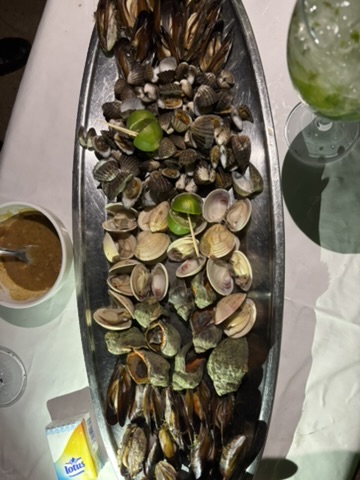
When the waiter comes back, he’s holding a huge tray with mussels, clams and snails. Happiness definitely has a taste!
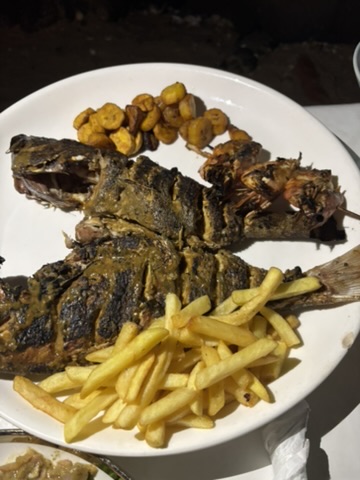
We start eating all that bounty and then the second shift starts: they bring the fish and the shrimps. Wait a minute… why do I have two fish on my plate, rather than one? I am really against food waste, so I always do my best to clean my plate, but now I’m stuffed to the brim and there’s no space for two fish. Regrettably, one of them will have to stay there, unless somebody volunteers to help me.
After dinner, we stroll around and, before we go back to the car, I’m introduced to the world of Senegalese fresh juices. We stop in front of a kiosk and I am given a glass of red juice that looks more like red wine. It’s bissap and it’s made from hibiscus. I have drunk hibiscus as an infusion (karkadé), but it’s the first time I drink it as juice. I like it a lot: it tastes less sour than karkadé – it must have a lot of sugar – and this one is mixed with mint, a great combination. So I end up with two bottles of juice, plus water.
Two days later, I leave Dakar with a suitcase considerably heavier than when I arrived. It contains boules carrées – squares made of baobab fruit pulp, used to make juices or eaten as a snack – a bag full of hibiscus flowers, coconut flakes mixed with ginger, a beautiful traditional electric blue cotton dress, a few bracelets, a keychain – which I’m using right now – and a few kilograms of fruit (madd, a tangy local fruit, mango and plantain). And a heart filled with gratitude, longing to come back as soon as possible.
On the way back, karma decides to punish me (though I still can’t figure out what I did wrong). This time I don’t win any upgrade, and my second flight is canceled: instead of arriving home in the late morning as planned, it is almost 8 pm when I open the door.
My sister is there waiting to have dinner together. I need to hide the coconut, otherwise she will finish it all before I can taste it.
And I do go back, in September, this time with my diving gear. But that is another story.